
Well, at least I’m wrapping up two months of reading rather than four months like last time. So. You know. Progress. In September, I read six books, and in October, I read 12. So overall, not bad reading months, but we can certainly tell that my anxiety brain/current wave of depression are having an impact from my reading numbers earlier in the year.
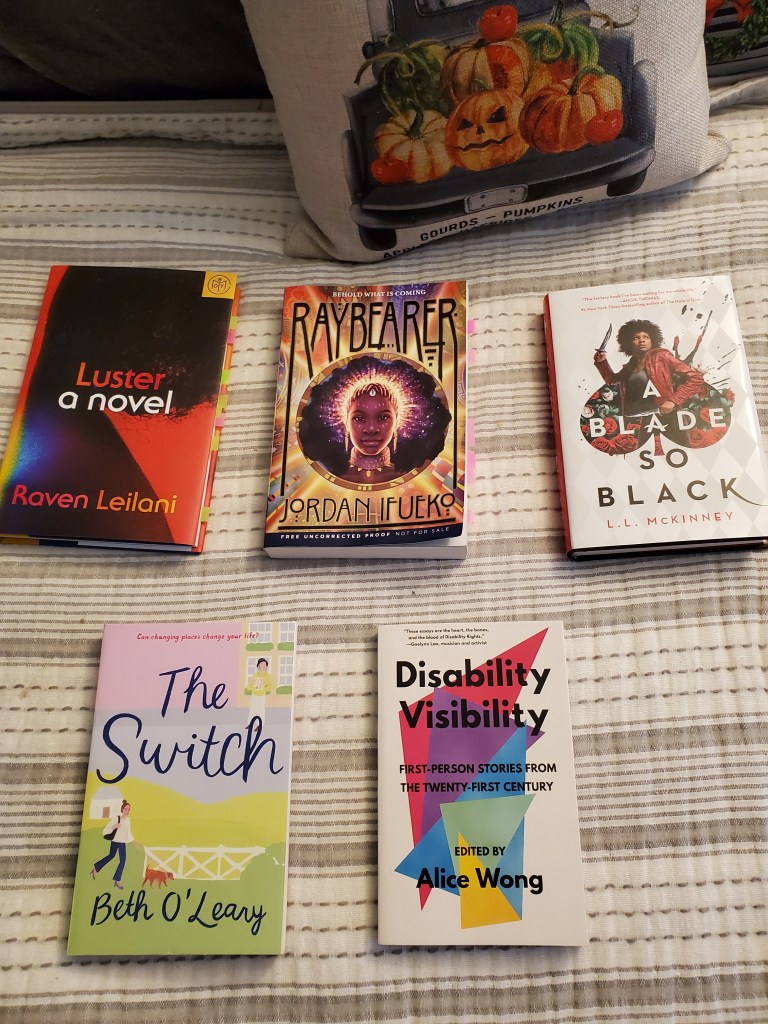
September was actually a really great reading month quality-wise, if not the most productive in quantity. It was also the month that I went back to work after a three-week furlough and….that was an adjustment that also contributed to my low numbers. But let’s focus on the positives! All of the six books I read, I rated either four or five stars.
Let’s start with the book that is not pictured here, The Most Fun We Ever Had by Claire Lombardo. I borrowed this from the library (! which was very exciting, it was in the first batch of books I grabbed after they reopened physically) and had to return it before the month ended. This was another title in the Women’s Prize longlist that I was trying to work my way through. That quest has significantly slowed at this point, but I’m still working on it! I rated this one four stars. Was it a lot of rich white people problems? Undoubtedly. And it even acknowledged that to itself. But it also so keenly explored the interiority of one complicated, messy, joyous family, and as a member of a big family (though admittedly not anywhere near as affluent as the Sorensons) and a sucker for multigenerational tales, it really hit home in such a poignant fashion. The way you can love and envy your siblings in the same breathe, and feel like everything is so much easier for them—and they can feel the same way about you. The way it’s somehow so easy to forget that your parents are people, and not omniscient beings. The struggles to communicate. The layers of secrets and misunderstandings and assumptions. The “inability to believe they’ve grown up” feeling about a sibling who you technically could have given birth to yourself. (On the eve of my youngest sister—who was born when I was a sophomore in high school—turning 18, this especially hit home.) The shorthand languages and the knowledge of just what will be the most hurtful—and also being ride or die, if it came down to it. Certainly not universal, not everybody has a biological close-ish disaster of a family, but extremely relatable for me. (Is that code for me sobbing at several points in this book? It is.) Definite content warnings on this one for stillbirth, postpartum depression, cancer, and death.
Two of these I read for two separate book clubs: Luster by Raven Leilani is just…indescribable? It captures so much of what it means quintessentially to be a millennial, and I felt extremely seen in many spots. It’s so deceptively short, and is not really at all about the thing it claims to be about. The writing is incisive, and there were sentences that made me laugh out loud. I foresee myself re-reading this one often. (I’m realizing I didn’t really describe the book, and honestly I think it’s one that isn’t really served by me trying to do that…? Just try it out for yourself.) I also did a re-read, of A Blade So Black by LL McKinney, for another book club. Described as Buffy meets Alice in Wonderland, I think that’s a pretty apt description. It’s a YA retelling/fractured fairy tale version of Alice in Wonderland that is set in modern Atlanta, as Alice attempts to deal with the grief of losing her father. There are definitely some aspects of YA that I particularly am growing out of, but I appreciate that Black writers and writers of color are getting to put their own spin on particular tropes, which hasn’t always been the case, and in those instances, I usually end up finding those aspects that feel tired a bit more compelling. Overall, I still love this one as much as I did when I first read it two years ago. Then again, Alice x Buffy is VERY much my brand, so not really a surprise there. Now I just need to get to reading the other books in this series.
For work, but also just because I was interested in it, I read Disability Visibility: First Person Stories from the Twenty-First Century which was edited by Alice Wong. Recently I’ve been thinking a lot more about disability, both visible and invisible. About the narrative in our society so often being “bravery” and “strength” and “inspiration.” About how representation needs to be broad and nuanced. This one nailed it, for me. It’s a really phenomenal collection of pieces, the range of voices captured is a model for the breadth of representation we should expect, and of the intersectionality in talking about topics that we should strive to achieve. It made me question my understanding of what disability means—for example, the idea that mental illnesses are disabilities, which just may seem obvious but I don’t know that we treat them that way as a society. Essays have content warnings when they contain common triggers, and as is pointed out in the book, not including these is a form of ableism, which is a thing I’ve been saying for years but not as eloquently. Highly, highly recommend.
I felt incredibly lucky to get an ARC copy of Raybearer by Jordan Ifueko. Now that I work adjacent to the book world, sometimes there are these giveaways and I’ll just randomly enter, and so I very much did not expect it and then one day, there it was in my mailbox. Anyway, this is a new epic fantasy series, another stunning debut. Tarisai has basically spent her whole childhood being prepared to be sent to the capital so she can ingratiate herself into the inner circle for the young prince and ultimately kill him, a directive from her distant, withholding mother. So, so good, it has all the things I want in an epic fantasy book: strong worldbuilding, found family, political intrigue, magic, allegory. A strong 4.5 stars from me, giving Ifueko room to grow with the sequel.
And last but not least in September, I read The Switch by Beth O’Leary. I LOVED her book The Flatshare last year, it’s one of the top rom-coms that I suggest to people who are looking for that vibe, so I knew I had to grab this one. For me, it was perfection. The range of relationships and family makeups represented, the romance and sex life of a woman over the age of 30, the portrayal of grief, the grandmother and granddaughter relationship, the found families, the reminder to look beyond our assumptions about people and value the lives and stories that society at large neglects, the power of determined women. It also did this really amazing thing of being contemporary but also capturing like that really cozy, small town England feeling which is such a lovely and appreciated aspect of British books and media in my world. I might even like this one more than The Flatshare, which I didn’t think would be possible.
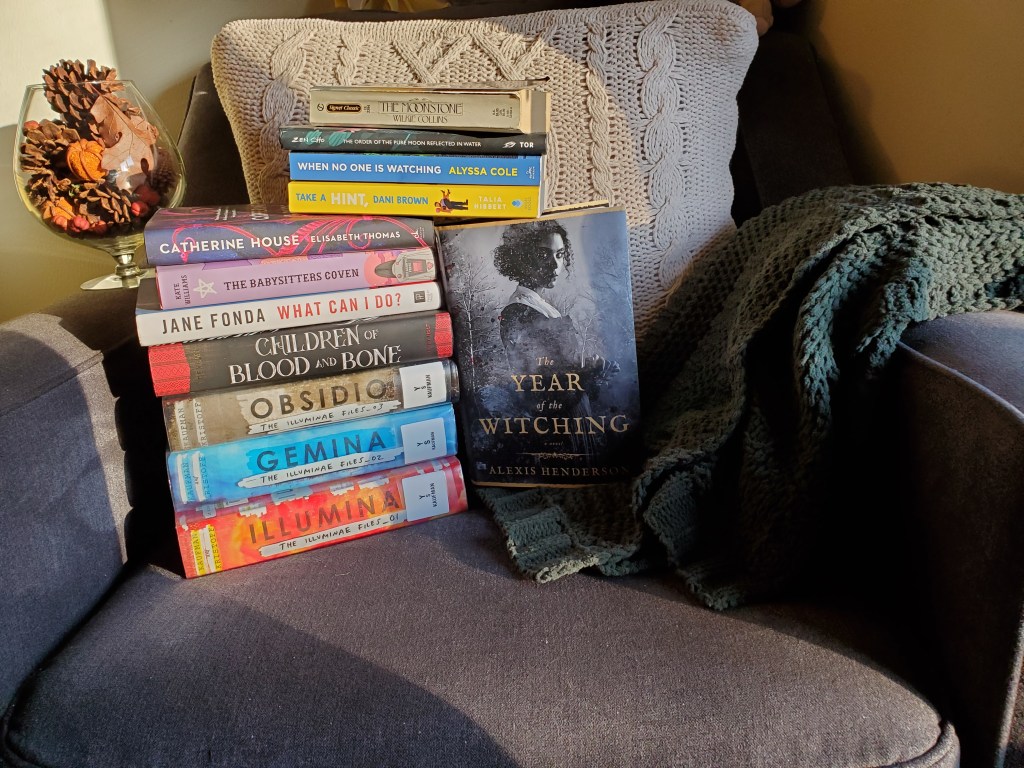
I wish I’d gotten to more spooky-ish reads, but October was a very stressful month personally (shocker, in this year of 2020) so I’ll take what I can get.
Let’s start with the one that I read for work. One of the only exciting things about quarantines and digitally producing events is that we as an organization have been able to put together programs that we likely wouldn’t have been able to make happen otherwise, because even if these big names wanted to join us, it’s unlikely that we could get them physically in the same space on the same date. So I was pretty pumped when we booked Jane Fonda talking with her long-time friend Elizabeth Lesser. In preparation for that, I read What Can I Do?: My Path from Climate Despair to Action. Not related to the content, but this book is heavy. I mean by weight. The paper is all a gloss and it’s just a hefty book that could do some damage. Not relevant. Many of us might remember seeing news of Jane Fonda getting arrested at various protests in Washington, D.C. In this book that is part memoir, part call to action, Jane talks about her experience working with climate organizations and leaders to create those weekly protests—which they called Fire Drill Fridays, about using her cachet as a Hollywood name to get other famous people to buy in, and about what her hopes for the future are. Honestly, it’s a pretty even balance between her personal aspirations and actual environmental, climate knowledge and information. I appreciated her using her platform, including this book, as a vehicle for amplifying voices of marginalized organizers who might otherwise not have been heard by such a large audience. Each chapter of the book focused on a particular intersection with climate change: the oceans, the military, water, environmental justice, and more. There was a chapter about women and climate change. There was a chapter explaining the Green New Deal. Throughout the book, there are bits written by people who joined her during Fire Drill Fridays, from fellow celebrities to long-time climate organizers. At the end of each chapter is a section telling people what they can do in their own lives to address that particular subset of climate action. I’m loathe at this moment in time to give white people credit for anything, but if Jane Fonda can use her fame and following to back-door some activism into the lives of older white folks, I’ll call that a win, and I think this book might just accomplish that.
I read a couple of books for book club: Children of Blood and Bone by Tomi Adeyemi and When No One is Watching by Alyssa Cole. COBAB was a re-read for me. I still really love this series, but I remembered how much I was driven mad by the injection of romance into the story because it made me feel EXACTLY as I felt when I watched Newsies as a stage show. (I won’t get started on that, because I’ll never stop.) The worldbuilding is strong and compelling for me, the “chosen one” trope felt new. I’m looking forward to the rest of the series. (Spoiler alert: I’ve already read Children of Virtue and Vengeance during November, and I didn’t love it, but I honestly think it’s classic second-book-of-a-trilogy syndrome.) When No One Is Watching was brand new, the first thriller/horror from romance author Alyssa Cole. I’ve loved the books of hers that I’ve read, and I’d been hearing so much buzz about this one. It was pitched as Rear Window meets Get Out, and I appreciate the commentary and psychological elements of the latter, and while I’ve never seen the former, I feel like I have because it’s enough in the zeitgeist. Overall, I felt like the writing quality, the twists, the characterization, and the commentary made it a strong four star for me. Did I love everything about it, did I think every choice was the perfect one at the right time? Well, not necessarily. I agree that the pacing, especially at the end, felt slightly rushed, sure. Was it a solid first step into the genre? Undoubtedly, and I hope we get to see more from her in this area. I actually loved the interplay of the romance element, there were moments that were genuinely chilling and unsettling, and there were also a few points where I laughed out loud.
At the end of the month, my family experienced the death of our third family dog in the span of 18 months, our new puppy who we’d just gotten in July and got out of the yard and hit by a car. I was bereft, so I escaped into 2000 pages of space teen angst with the Illuminae Chronicles (Illuminae, Gemina, and Obsidio), which a bunch of the people I subscribe to on booktube just will not shut about. They were just FINE for me. I did really like the mixed media format, it made them incredibly quick, but overall the writing was mediocre and melodramatic, and extremely formulaic. The three books were all essentially the same, and I honestly got bored. But I read them, so I can say I’ve done that now.
I read a couple of little random things. The Order of the Pure Moon Reflected in Water by Zen Cho. The cover of this novella is freaking gorgeous, so here’s a full size version of it.
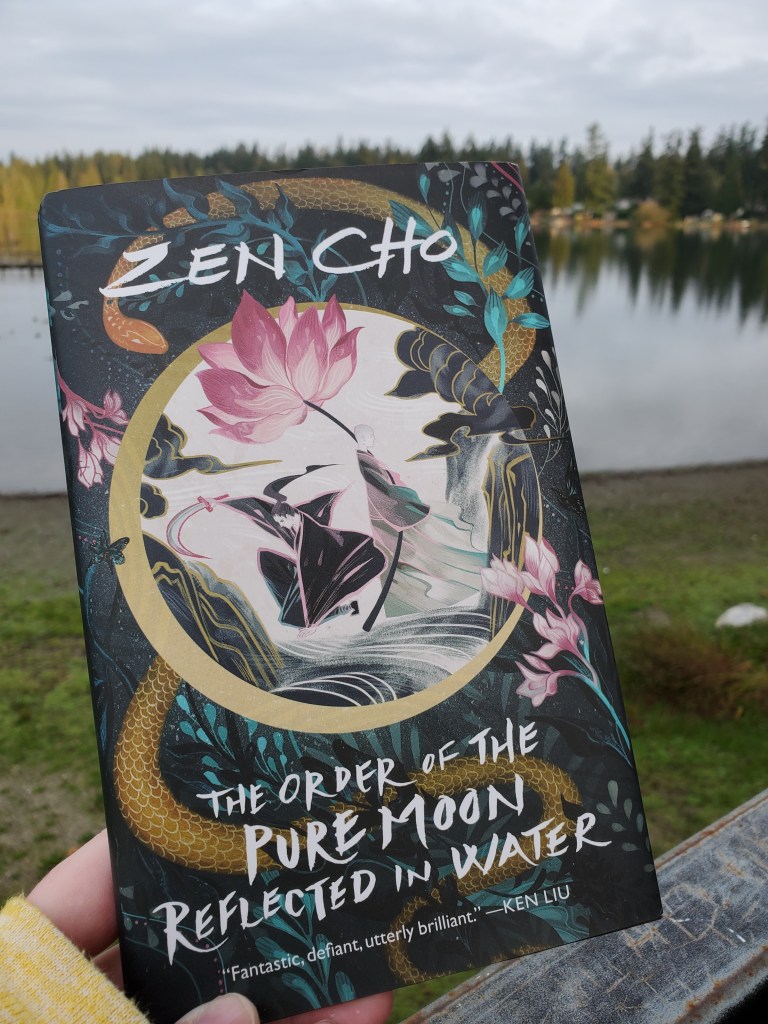
I had no idea really what to expect with this one, I honestly saw it on somebody’s Instagram and it was a cover buy, but it was a really charming story about a band of bandits, one of whom walks into a coffeehouse where a young votary of the Pure Moon is working and incites an argument, and then she joins the band. It’s super queer, very found family, soft fantasy/paranormal vibes. I only wish there was more to this story, but I’m looking forward to discovering more from Zen Cho. And then I also read Take a Hint, Dani Brown which is the second in a trio of books about the Brown sisters (the first being Get a Life, Chloe Brown). This one features Dani Brown, the middle sister who is a bisexual, looking-for-a-hookup-not-a-relationship, PhD student who fake dates the security guard in her building at work. After a fire drill gone wrong has them accidentally going viral and people making assumptions—and donating much needed funds to Zaf’s charity—they just decide to go with it, and shocker, love grows. I actually liked this one a bit more than the first, mostly because the enemies-to-lovers thing is not really my jam. But this one was friends-to-lovers, which is very much my jam! I really appreciate the curvy heroine rep (also present in Chloe Brown), the bisexual rep, and the representation of mental health and anxiety. I thought the exploration of toxic masculinity with Zaf’s work with young men was solid. Zaf was a soft hero and Dani was a jaded heroine, and I honestly really love that dynamic.
And I saved the spooky-ish books for last. It only took me 152 years, but I finally read The Moonstone by Wilkie Collins. It was funny! And also pretty racist! Long and sometimes boring, but I’m glad I can finally cross it off the list. I read The Babysitter’s Coven, which I bought last year. Eh, this one was just okay, for me. Probably 2.5 stars. I admit that I had high hopes because the cover is gorgeous (and soft touch!) and I did have a good time reading it. But there were too many things that irked me to truly like it. Also, completely acknowledging that I am not the target audience for this book, as I am no longer a young adult. The Baby-Sitters Club meets Buffy is an apt comparison, but this book references both of those other franchises in a way that is meant to be self-aware, but just ends up feeling cheap and like a lazy way of worldbuilding. It also relies on the nostalgia for those two things, and I would say that the Venn diagram of people who love BSC (before the Netflix revival, when this came out) and Buffy, and current young adults…I’d say those two circles do not overlap at all. The dialogue felt unrealistic, and how a person assumes that teens talk rather than how they actually do. Calling non-magical people “normies” is incredibly annoying to me. The fact that their powers were “innate,” and they didn’t have to work on them at all…frustrating and EASY. Especially when Esme “sends her mind in” to the portal, like what even is that? Even people who have innate abilities with things in the real world still have to work at them. The flush when the creatures go back through the portal was tacky. Esme’s mom insists that she’s lost her powers, but she somehow realizes that while they’re in the “bat cave,” which dampens all powers so how would she really know? Almost none of the characters felt fleshed-out in any sort of real way, they’re all there to serve Esme and not as characters in their own right, and the worldbuilding was almost nonexistent. I did feel like it was mostly well-paced and I did speed through it, especially the last half, but I don’t know that I’d pick up further books in this series.
Then I read Catherine House by Elisabeth Thomas. I’ve been hearing so much about this—very divided reviews!—and I’ve also been hearing so much about dark academia. I bought this sometime during the summer, maybe after the Juneteenth Book Fest? I gave it 4 stars, maybe even 4.5 stars, I’m going to have to ruminate on it. This is such a weird comparison, but it reminded me a bit of how I felt reading This Is How You Lose the Time War, in that things were unexplained and it wasn’t about finding answers, necessarily, there wasn’t a concrete plot or suspense driving things forward. It was all menace and haze. If you like reading about cults, you might like this book. There’s definitely elements of cultiness here, with the chants, and the levels of devotion that so many exhibited toward Catherine House. Ines as a main/POV character is super apathetic and weird, and I loved it. It’s also kind of incidental to the driving force of the book, but I also loved how much casual queerness there was. From Ines’ point of view, she explores the debauchery and partying that happens amongst them all, as new adults and also in this extremely isolated space, and she slept with a lot of people, boys and girls, and it was just normal and accepted; even though the rest of it was really weird and often terrible, to have a fantastical book that imagines a world where that is the case was lovely. There were some sci-fi elements in there as well, with plasm (which is never explained, so don’t get your hopes up there!) and the idea of eternity and immortality. It totally made sense to me that Elisabeth Thomas went to an Ivy League, because I think there was some commentary on the prestige and allure of somewhere that is so exclusive and lauded. This book defies genre boundaries, and it’s definitely not going to be for everyone, but it was decidedly for me.
And then I ended the month, reading entirely on Halloween The Year of the Witching by Alexis Henderson. This one also had elements of cultiness to it, but in the guise of religious and patriarchal extremism? It was a weird, haunting, lovely, somber read. It made me think a lot about fundamentalism, and cults, and the thin line between cults and religions, and the corruption of power, and convenient racism, and the strength of women. Hex the patriarchy. This was pretty unputdownable and almost no good things happened but I still am glad I read it. (Content warning, rape of a minor is mentioned but not portrayed.)
And that’s it! It’s nearly the end of November and I finished my September and October wrap up but i did it so…progress!
 Jo In Real Life