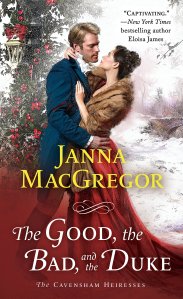
The Good, The Bad, and The Duke—Janna MacGregor

The Good, The Bad, and The Duke

Oh boy did I pick the wrong time to be reading an advance copy of an historical romance. I happened to start this book just in time for the Kavanaugh confirmation hearings, and I hated just about every dude in the world at that point, and THEN I dove into some historical romance tropes that I already abhor to top off all of the latent rage. So I’m prefacing this entire review with that disclaimer, because it’s possible that at another time, I might have had some different, less irritated feelings about this one.

The Good, The Bad, and The Duke

Lady Daphne Hallworth gets left behind in London during the holidays when both her brother and her mother think she is with the other on their journeys out to the country. Rather than follow them immediately, she revels in her newfound freedom, planning for her future life of independence. Her plans get thrown a bit out of wack when her reticule is stolen. She doesn’t care about the bag itself, or the money inside—no, she is concerned about her personal journal with VERY intimate information being revealed. Not only does she have private information about her sister’s death that would cause pain for everyone if it came to light, but she also has some very detailed fantasies that would be super embarrassing. When she runs into a gambling hell to attempt to retrieve it, she encounters an estranged family friend—Paul, Duke of Southart—who wants to help protect her reputation and get her journal back. Romance ensues, as it tends to do in books like this.

I do appreciate the fact that Daphne is not a 16-year-old, or even 18-year-old, young girl who is drawn in by a rake. She is a 28-year-old woman who might be considered a spinster well settled on the shelf. And I think MacGregor did a solid job of showing that, when you like someone, even a small gesture can have a huge impact. But from there, it was kind of downhill for me. The most annoying thing is, I think this book is actually attempting to show a relationship and people ahead of their times. For example, one of Daphne’s aims is that, as an independent woman, she wants to open a home for unwed mothers. Not something that you typically see represented during this time in romances. And then, you’ll get a moment like this in chapter four: “Paul’s gaze strayed to her velvet dress, which emphasized her straight backside and hugged her plump, perfectly shaped bottom, which begged for a man’s touch.” Now, it’s a romance book, of course there are going to be descriptions and appreciation of body parts; it’s the editorializing of “begged for a man’s touch” that really irks me. And as much as there seems to be an attempt at showing that both of them have equal power in the relationship, and Paul is not the most alpha of alpha males that I’ve seen, he also still says and thinks things like whether or not he’d “allow” certain men to be around Daphne. Not exactly a woke bae attitude, even for the time and place.

Beyond that, there was some phrasing that stood out to me in an incredibly negative way. Something like, “He could feel her feminine softness unfurl around him.” What? Or, “His cock was currently throwing a temper tantrum that it had been teased without any promise of a release in the near future.” Or even, “Immediately, his cock twitched like a setter ready to point. Or a pampered lapdog begging for a treat.” Yikesssss.

giphy

Here are some of the historical romance tropes in this book:

  • Second son in line to nobility, a playboy who has to straighten up and fly right when his older brother dies unexpectedly.
  • Not only was he a playboy, but he got around and everyone knows of his prowess.
  • Man smells like sandalwood.
  • Man gives woman a stupid and annoying nickname that he uses incessantly even after she has asked him to stop.
  • Man is tumescent immediately and always in her presence, and has an animal draw to her so he just can’t control herself. (LITERALLY THE LAST THING I NEEDED TO READ ABOUT AT THIS MOMENT IN TIME WAS MEN WHO JUST CAN’T CONTROL THEMSELVES BECAUSE DICKS AND TESTOSTERONE AND THE SOCIETAL ALLOWANCE THAT MEN DON’T HAVE POWER OVER THEIR URGES.)

Now I’m not necessarily shitting on tropes; they’re formulaic because they work, and the romance book world is a billion-dollar-a-year industry. So they’re doing something right. But these are some of my least favourite, so it irked me even more.

And the icing on the cake? OF COURSE she winds up pregnant in the epilogue. Because what is a historical romance heroine for but to fulfill the egotism of reproduction.

So anyway, thank you to NetGalley and St. Martin’s for an advance copy in exchange for an honest review. The book’s publish date is November 27, and you can find more information here.
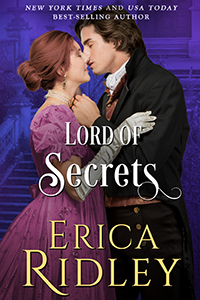
Lord of Secrets—Erica Ridley

Lord of SecretsNora is a paid companion to her distant cousin Lady Roundtree, who has broken her leg. The only reason she took the position was to help support her younger brother and elderly grandparents in the country, where she usually lives. She’s not used to the way that things are done in society. She’s not great at reading and writing (she has dyslexia, though it’s never stated that way) and so she draws little caricatures of society gatherings for her family back home. Little does she know, her brother started selling them to a publication, albeit anonymously, and the society she has depicted in these caricatures is not thrilled to see their laundry aired. Heath, a member of that society, is also known as something of a fixer. He is hired to track down the identity of the caricaturist. But he didn’t expect to develop feelings for this new lower class girl and he definitely didn’t expect her to be the person behind the pen.
Whew. I really got on a tear of requesting romance books from NetGalley. Honestly, I was just looking for some escapism, and historical fiction romance usually is great at that. Not as much this time around.

This is number 5 in the Rogues to Riches series. I hadn’t read any of the others in the series, and the completionist in me is bummed by that, but the recoveringcompletionist in me is quite pleased with this indication of progress.

Overall, this book was meh for me. Not bad, not great, just kind of meh. Which, honestly, equates to a bit unforgettable in the long run.

I appreciated that Nora wasn’t a Mary Sue-style perfect heroine, though it did seem like the only thing keeping her from being that was this kind of shoehorned dyslexia. Now, I’m all for more characters in literature that have disabilities, but the fact that she had so much self-hatred about it (realistic for the time period but disappointing considering other “not realistic for the time period” moments) was not my favourite.

Although it was somewhat anachronistic or less prominent in history than it might seem from this novel, I loved how much Heath’s sisters took Fleetwood Mac’s advice to heart, and went their own ways. I know at least one of them is the subject of another book in the series, and I enjoyed the snippets that we got with his sisters so much that I’m actually interested in reading that book, even though this one was just whelming.

Alright, let’s get into the things I found less than stellar. Insta love x100000000. Of all the tropes, this is among my three least favourite. They met once at a dance, he was nice to her, and immediately she’s in love with him. As I noted on my Kindle, “Extreme, instant infatuation is a good start to every relationship.”

I noticed a theme that is prevalent in historical romance which has always bothered me but which I haven’t been able to hit on until this book. So often, the heroine is someone who shirks the expectations of society and does things differently, and that’s why the hero falls in love with her. BECAUSE she’s different. Which is basically just the old-timey version of “you’re not like other girls.” The heroes especially usually deride the other girls, the ones who are hunting for husbands. Like, what do you expect of them? They’ve been told their entire lives—by society, by their friends, by their families—that the entirety of their worth is wrapped up in who they are able to “catch” as a husband. You’re really going to be an asshole about a girl who does what she’s been told is the most important thing to do every day of her life? Ugh.

Honestly, the biggest obstacle to loving this book for me was that it seemed like nothing happened. The pacing was so terrible, and as a result, the passage of time was quite confusing. It almost felt like this had initially been planned as a novella and then had to be stretched into a novel-length piece. Not even character development was happening during that time, which might have been the only reason I would excuse such slow pacing. I got to 62% in, and made the note that it felt like nothing had happened. At 72% in, FINALLY a single kiss! Not another kiss until 90 PERCENT INTO THE BOOK. What even am I doing here?

As I mentioned, I would be interested in reading the final book in the series, Lord of Vice, which is about Heath’s sister Bryony and a gaming hell owner Max. They were both introduced in this book, and immediately, as soon as Max was introduced, I made a note that I was CERTAIN he was going to get with one of Heath’s sisters. And he does. I’m into it. I am a bit of a sucker for a rogue gaming hell owner story. There are surprisingly a lot of them.

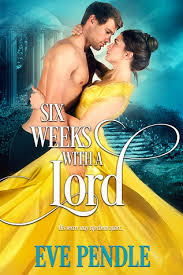
Six Weeks With a Lord—Eve Pendle

Six Weeks with a LordOh boy was this one ever not for me.

Warning: shouty capitals ahead.

Content warning for sexual coercion and mention of rape.

The general plot is this: Everett is an impoverished lord who needs money to pay off his brother’s debt and helping to stabilize his herd after a disease has ravaged it. Grace is the daughter of a shopkeeper who is left penniless after her father dies, and who refuses to marry the man her father chose for her, but she needs somebody to marry her so that she can get her inheritance and win custody of her younger brother. They’re both essentially looking for a business arrangement, Grace agrees to split her inheritance half and half for such a situation, but when Everett’s biggest requirement out of the deal is that Grace go through the motions of pretending to be in love with him for at least six weeks, for the sake of the morale of his people, what results is so much more. Spoiler alert? But it is a romance book, so you could have extrapolated.

Continue reading “Six Weeks With a Lord—Eve Pendle”

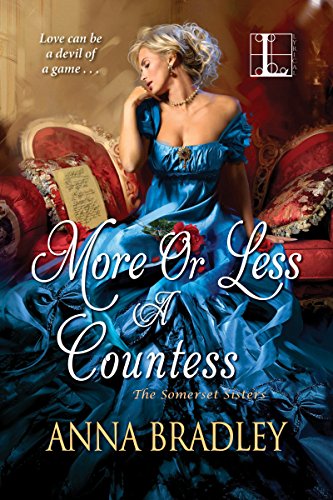
More or Less a Countess—Anna Bradley

More or Less a Countess

“Violet didn’t mind the dark. She’d spent many evenings alone in her grandmother’s library, cradling dusty books in her hands and pondering the pattern of invisible fingerprints on those old, crackling pages.”

SAME, Violet.

Violet Somerset is an opinionated, odd girl who just wants to love books and also write one about true crime locations in Regency London. So, basically, a legend. Nick Dare is a lord who needs to marry and soon, according to his grandmother. When he mixes up Violet for her younger sister Hyacinth after returning to the London scene following an absence, Violet doesn’t correct him; she lets him continue to think that she’s Hyacinth, of the amazing pianoforte skills, so that he will escort her on outings to various crime locations which would be unseemly for her to visit on her own. Though both initially sees the other as a match of expediency, they gradually grow closer until they eventually…consummate their relationship. It’s only AFTER this point that Lord Dare learns that Violet is not, in fact, Hyacinth, but begrudgingly marries her anyway because, hey, he’s been inside her, and that was the done thing in those days. And then, despite the fact that they’ve started their marriage out on a lie, all things work out and there’s a happily ever after.

Though this is the second book in the Somerset Sisters series, it worked just fine as a standalone. (Note to self: stop requesting books without finding out whether they’re part of a series first.) I’m assuming the first book is about Violet’s sister Iris, who we encounter as well as her new husband, in More or Less a Countess. I didn’t love the twee flower names for the Somerset sisters, but we can’t always get what we want, I suppose.

I did EXTREMELY relate to Violet. A girl who loves true crime, libraries, and cemeteries? Yeah, that’s a romance novel heroine I can get behind, for sure. Also, the very first thing that happens is that she gets stuck in the library when Nick comes in and tups a married woman. Who hasn’t been caught in an awkward situation, and then gets stuck when things have passed the point of no return? We’ve all been there.

The central conflict, that Violet has lied about her name, was SO contrived to me. If this were real life, sure, lying about your name might be a signifier of an underlying tendency to deceive. Or it might just be that it got past the tipping point and it became too awkward to correct him. Granted, I think the bigger problem for Nick is probably that she then decided to use him, but still. Not the best of even terrible fake conflicts that I’ve encountered in romance novels.

Even the secondary conflict, when Nick discovers a sketch that Violet made of him entitled, “The Selfish Rake” from the time that she watched him fuck the married woman in the library, was kind of ridiculous. He gets upset that she’s entitled the piece that way, but, dude, you were. You were undoubtedly and assuredly a selfish rake. It did make a little more sense that he actually overreacted to that because of the specter of his dead older brother, the golden child, and his own feelings of inadequacy that he won’t ever measure up. Still, not an appropriate reason to be a dick to your new wife, even in Regency England.

There were some really great tropes in this one too. One that I’ve been noticing more and more recently is the precocious but naive young woman who understands the act of lovemaking intellectually but asks questions of the experienced man on practicality, which, of course, gets him immediately and irreversibly hard. To be fair, the sexy times were pretty compelling, so it was worth reading for them alone.

There was some fairly funny dialogue, most especially from Gibbs, Lord Dare’s valet. The writing was a little repetitive in places, especially when addressing Violet’s past, and even more so when talking about Lord Derrick.

Overall, a pretty solid three, three and a half stars from me. I didn’t love it, but I liked it enough to read more by Anna Bradley, and I don’t think I’ve read any of her stuff before.

The book has a scheduled release date of August 7. Find out more here.

Thanks to NetGalley and Kensington Books for this ARC in exchange for an honest review.