
Just about a year ago, I learned that the musical theater company where I work was going to be presenting a new musical about Degas and La Petite Danseuse de Quatorze Ans (aka Little Dancer Aged Fourteen, one of his most famous sculptures).
My first reaction was to freak the fuck out because the phenomenal, powerhouse writing team of Ahrens and Flaherty (of Once On This Island, Anastasia, Seussical, Ragtime fame, to name just a few) and Tony Award-winning director/choreographer Susan Stroman were going to be in residence at The 5th.
My second reaction was, “Really? A musical about Degas? Wasn’t that dude kind of a dick, like most artists around that time?”
The show title, originally Little Dancer, was changed by the creative team to be Marie: A New Musical, a nod to the young woman who posed for the statue, Marie van Goethem. The team was specific about the name change: they made the change because the focus of the show is on the dancer, and not so much on the artist. Lynn Ahrens said, “It feels right to honor Marie, this unknown young dancer who’s actually now the most famous dancer in the world. It’s time the world knew her name, and her struggle, and her triumph.”
As a dedicated history nerd (my major at university and a lifelong passion), I have always been fascinated by the stories that are unwritten, the histories we may never know. Recently, there seem to be more and more stories shared that had previously been forgotten or lesser known, often shared on Twitter. When I learned more about Marie and the topic of the show, I thought it would be interesting for the theater to put together some dramaturgical piece(s) about forgotten women from history. You will likely not be surprised to find there are a lot of them, because most of history was written almost exclusively by men. And, historically, most men didn’t seem to care so much about documenting the contributions of women. I guess they all forgot we gave birth to them, but that’s fine.
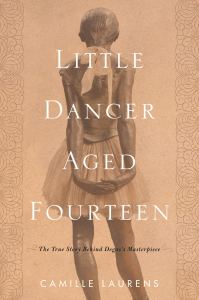 As preparation for the show started ramping up, and as there seemed to be more and more renewed discussion around the things we forgive for the sake of art, it turned out there was about to be a new book released about Marie. Little Dancer Aged Fourteen, written by well-respected and award-winning French novelist/essayist Camille Laurens and translated by Willard Wood, is an incredibly digestible book at 176 pages. We at The 5th were lucky enough to be sent a couple of copies of the book by the publisher. (Thanks, Other Press!)
It’s hard to believe that something so petite would also be well researched, informative, and at moments editorial and shockingly relevant to today’s political events, but all of these are true. The contextualizing of Marie’s time and space are eye-opening, including some very unexpected revelations on my own part. But we’ll get back to that later.
This book is stuffed full of information. In the first half of the book, Laurens shares about her quest to find out more about Marie van Goethem, to the extent that she found birth and death records for other members of the van Goethem family (including trying to follow Marie after her departure from the Opera (the organization that employed young dancers at that point in time), when history truly loses track of her). Laurens also went to the Opera and found payment receipts for Marie and other dancers, which the Opera still has on file. From the receipts, Laurens was able to discern that Marie was a young dancer who was often in trouble with her instructors and employers–dancers were often given wage penalties for things like tardiness or insubordination. Insubordination included things like talking, laughing, or crying. (I can’t imagine NOT being tardy or “insubordinate” if I were working 10-12 hour days, six days a week, so I’m sympathetic to Marie.) Laurens also relays how the van Goethem family was incredibly reliant on the young Marie’s salary via the Opera, as the patriarch of the family was not around (though it’s not clear whether this was because he had died or returned to Belgium). That’s a lot of pressure to put on a young person, even given the societal differences between then and now.
To the credit of Marie’s mother–who was also called Marie–there were certainly less safe ways for children to make money in those days, and children were definitely having to make money to help their families. As Laurens states, “Boys could rent out their arms to work in the mines or on the farm; girls rented out their legs, their bodies.” Backstage at the Paris Opera was a known opportunity for the “little rats” to supplement their incomes by earning “protection” from male admirers:
“Children reached sexual majority at the age of thirteen, according to an 1863 law — the age had previously been eleven. Backstage, procurement was the quasi-official function of a mother, who was expected to ‘present’ her daughter to male admirers. The police shut their eyes to it, as did the Opera administration. Those who reserved seats in the orchestra or private boxes in the balcony, the ‘subscribers,’ had the free run of the foyer, the backstage area, and the private drawing rooms, which became trysting sites. Others, less fortunate and unable to obtain the privilege, waited in the hallways, the vestibules, and at the exit.”
Though it’s possible that Marie’s mother engaged in what we would consider pimping, it’s also possible that the reason Marie (and before her, her older sister) posed for Degas was to help generate additional income for the van Goethem family.
In the second half of the book, Laurens relays more information about Degas himself, his life, his process with the statue, and his intentions. While there were some fascinating tidbits in this section – like the fact that Degas never intended for the sculpture to survive after his life ended, which is why he made it out of wax to begin with rather than a different material with greater longevity AND that x-rays of the finished sculpture show that not only did Degas endlessly rework the piece, but that, in addition to the wire skeleton, it is full of random objects, including paintbrush handles, rags, wood shavings, cotton wadding, drinking glasses, and cork stoppers – the most striking portion of this section was the editorializing from Laurens, relating the state of things in 19th century Paris with today, specifically with relation to refugees.
After Marie was fired from the Opera–likely partially as a result of more time modeling for Degas, causing her to be less diligent with her dancing–there is some indication that her younger sister continued dancing for a while, even becoming an instructor in later years. Laurens scoured the vital records database in an attempt to find out where Marie went, and though she discovered more concrete information about Marie’s older and younger sisters, it seems as though Marie’s fate will remain a mystery, at least for now.
The one thing that I will say I didn’t LOVE about this book were the excuses, or even explanations, given about some of Degas’ opinions. For example, Laurens relates that, while Degas was an anti-Semite, he wasn’t “rabid” in his anti-Semitism…Okay? Still seems pretty bad, Laurens.
Or how she forgives the advantage that Degas takes of Marie by saying that he likely didn’t commit statutory rape with Marie because of his general and well-known hatred of women. And that it was believed he was celibate (so he couldn’t have abused her!) because of that misogyny. Cool. Cool, cool, cool.
Marie’s story, and the book itself, have certainly made me feel more cognizant than ever of the role that we have historically given to women “muses” being objectified in art. It is just an extension of my already heightened awareness of spaces where we have allowed the product or the “genius” of most often male artists to be a priority over the harm done to subjects.
(Lengthy tangent from the central theme of this post–which is girls and women forgotten by history–but one of the most staggering realizations to me was that capitalism, and more specifically the racist undertones of capitalism, is modern-day determinism. Determinism was the belief that events were outside of our control, based on particular aspects of our person, most notably aspects that tended to correlate to race and gender, in the minds of 19th century Frenchmen. The facial and cranial features that indicated criminality were, shocker, often similar facial features and characteristics of people of color. Here’s the passage that incited this for me: “France was industrializing, and its working class was growing in importance. Paris, under the influence of Baron Haussman, was seeing its heterogenous population shuffled together in individual buildings — the rich on the lower floors and the servant class under the eaves. The ruling classes needed to be reassured about their privileges. Small wonder that they clung to theories that ‘proved’ the natural superiority of the bourgeoisie over the working class, the rich over the poor, the whites over blacks, and men over women. Man, according to this view, which is rife with racial and gender chauvinism, is not influenced so much by his social and cultural environment as he is determined by heredity and the laws of biology. Therefore, workingmen, prostitutes, blacks, and women were naturally inferior by reason of genetic flaws or an incomplete development. Social hierarchy was justified by nature itself, with rich white men at the apex and other races, women, and the poor in the lower depths.” HMMMMM, SOUNDS FAMILIAR. This almost could’ve been written for modern-day America. Although we claim to have this society that says you can and should pull yourselves up by your bootstraps, there is absolutely a belief, especially among conservatives, that people who are poor are so because they deserve to be, that there is some moral failing on their part. Meanwhile, those who are rich are so because they also deserve to be. These people also don’t seem to do a lot of examination of these views and how they are so intrinsically tied to the racist history and present of this country.
It is also worth noting that, though it was a general belief that people of color, poor people, and women were destined to be criminals, there was also a HUGE demand for “ethnographic curiosities and exoiticism.” Again, if that ain’t directly relevant to the way that many white artists today appropriate Black and POC culture while doing absolutely nothing for those communities, I don’t know what is.)
Back to the point. Reading more about Marie, I was on the lookout for more stories of women that I had never heard of before. One day, I was on the Twitter when someone shared about Fatima al-Fihri, a Muslim woman who is credited with founding the oldest existing, continually operating educational institution. She founded it in the 9th century CE, with money left to her by her father who always supported and encouraged her thirst for knowledge. Of course, women like al-Fihri don’t support a certain current agenda and rhetoric in this country, so I wasn’t surprised to have not heard of her. I thought that was a great starting point, so I looked for any materials at the library that might mention her. Two books, published with less than a year between them, both filed with amazing women mostly lost to history, were available so I grabbed them up to continue to indulge myself and my quest for stories.
Bygone Badass Broads: 52 Forgotten Women Who Changed the World was the first one. This one was written by Mackenzi Lee, who started the “bygone broads” idea as a Twitter thing, and then transitioned it to the book, and illustrated by Petra Eriksson. it was also published first, by just over seven months, on February 27, 2018.
This book is organized chronologically based on the lifespan of the woman being discussed. Each woman has an illustration of her (or of what she is believed to look like, if we’re not certain), comme ca…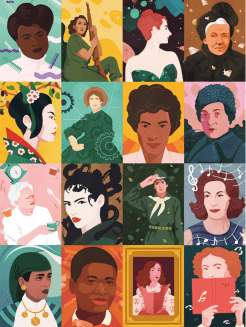
…followed by a pithy two pages about her lifespan and how she changed the world. The language and tone here are incredibly colloquial, which I actually loved. For example, something like this from the section on Agnodice: “It seems absurd that men could have so much control over a woman’s reproductive health, what women could do with their own bodies, and the fates of the babies they’ve birthed. Oh, sorry – I’m talking about Ancient Greece, not contemporary America.” Or this, from the section about Irena Sendler, who helped save twice as many Jewish children as Oskar Schindler during WWII: “In 2007, Irena was up for a Nobel Peace Prize, but was not selected. Al Gore won instead, for a PowerPoint presentation about weather. Just kidding, climate change is real and important, and Al Gore, Imma let you finish, but IRENA SENDLER WAS ONE OF THE GREATEST WOMEN OF ALL TIME.”
I loved how full this collection was–basically one “forgotten” woman a week for a full year, if you wanted to look at it that way. Although it’s hard to pick, some of the highlights for me were:
- Alice Bell, born in 1892, an African American Seattle native, UW graduate, and scientist, who helped develop a process for fighting leprosy, and who tragically died at 24
- Queen Arawelo, whose catchphrase was “never have confidence in any man” and who took the throne for herself rather than letting a man run the show
- Khutulun, the wrestling champion of 13th-century Mongolia
- Ana Lezama de Urinza and Eustaquia de Sonza, the vigilante duo who Lee calls “the queer, femme Batman and Robin of Peru” (IF THIS IS NOT THE PLOT AND TAGLINE OF THE NEXT SUPERHERO MOVIE, THEN WHAT EVEN ARE WE DOING HERE?!)
- Isabella Stewart Gardner, who was an eccentric art collector and very carefully curated and laid out a museum in her home, and who left money in a trust when she died to keep the museum open on the condition that nothing be moved around or changed from how Isabella laid it out. If your name is Isabella, you always get in free. (This made me sob, for some reason?)
- Bonus fact: The museum is also the site of the largest unsolved art heist in American, but since Isabella’s trust stipulated that nothing could be changed, “the empty frames of the thirteen stolen paintings still hang on the walls where the pictures used to be.”
- Buffalo Calf Road Woman, the hero of the Battle of Little Bighorn, the person who is credited with knocking Custer off of his horse
- Bonus fact: Fearing the spin that racist white folks would inevitably put on the battle, “Northern Cheyenne tribal leaders called for a ban of silence about the truth of what happened at Little Bighorn lasting 100 summers, which was broken in 2005, when Buffalo Calf Road Woman’s story was finally told publicly.”
For the reasons I mentioned liking the book above, and a few others that I’ll mention below, I also slightly preferred Bygone Badass Broads to History vs. Women.
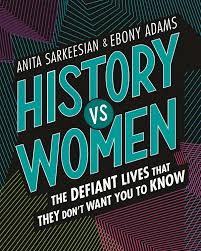
History vs. Women was written by Anita Sarkeesian, fairly well-known founder of Feminist Frequency, and Ebony Adams, and published on October 2, 2018. There was a fair amount of overlap in women included in the books–most notably, Fatima al-Fihri, about whom I had initially been searching for more information–which I actually didn’t mind because it meant I was better able to compare/contrast the two. I also super appreciated the inclusion and calling out of women who maybe did some less than stellar things, which History vs. Women stated as capturing the “fullness of women.” I also believe it’s important to recognize the range of women’s experiences and deeds, even those that are negative. (I will say, though, that I wouldn’t consider Margaret Thatcher a woman forgotten by history. I imagine the reason the authors wanted to include her was to emphasize some of the racist and homophobic policies and actions, but I don’t know that I would have chosen this as the place to do it.)
History vs. Women includes profiles of 25 women, organized by category: rebels, rulers, scientists, artists, warriors, and villains. In this way, I preferred Bygone Badass Broads, because organizing them chronologically makes more sense to me than trying to categorize them, especially since there is such an opportunity for overlap.
I also slightly preferred the writing style in Bygone Badass Broads. Though the language there was quite conversational, there was less editorializing. Editorializing in works of history/biography is fine with me, in general, but I was specifically looking for something that was more straightforward and informative.
Perhaps the biggest difference that determined my preference was actually the design. The design in Bygone Badass Broads was very simple and clean. The design in History vs. Women hurt my eyeballs. White text on a black background is not where it’s at, I have to say. Here’s an example of what that looked like:

Now imagine there’s also a glossy sheen, and you might get an idea of how that’s impossible to read. But not all of the pages were white text on a black background, so that even made it worse, because my eyes felt like they were constantly having to adjust to a new environment. The pull quotes also were in super random places–like in the middle of sentences–and totally interrupted the flow of the text, to the point that I ended up just skipping over them entirely. There could have been pertinent information in those pull quotes, but I will never know.
My biggest takeaway, though, from these three pieces was how upset I was to have not heard of any of these women during my history studies, and how grateful I felt that there will at least be some resources and (hopefully) greater focus on women’s contributions in university studies and media into the future. It’s no surprise that many stories about women have been lost to history. Hopefully, dedicated historians and storytellers will continue to unearth their lives and tell the stories of the remarkable women who helped pave the way, and who deserve to be remembered.
Further reading:
“The Story Behind Degas’ “Little Dancer” Is Disturbing, But Not in the Way That You Think” – Huffington Post, November 21, 2018
“‘Little Dancer’ Brings Us to See the Person Behind the Famous Degas Sculpture” – NPR, November 20, 2018
“Camille Laurens’s ‘Little Dancer Aged Fourteen’ Is a Fascinating Hybrid, and Obsessed with Obsession” – The New Yorker, November 20, 2018
‘History Vs. Women’ by Anita Sarkeesian & Ebony Adams Tells The Stories of 25 Of History’s Forgotten Women – Bustle, October 2, 2018
 Jo In Real Life